
Blog
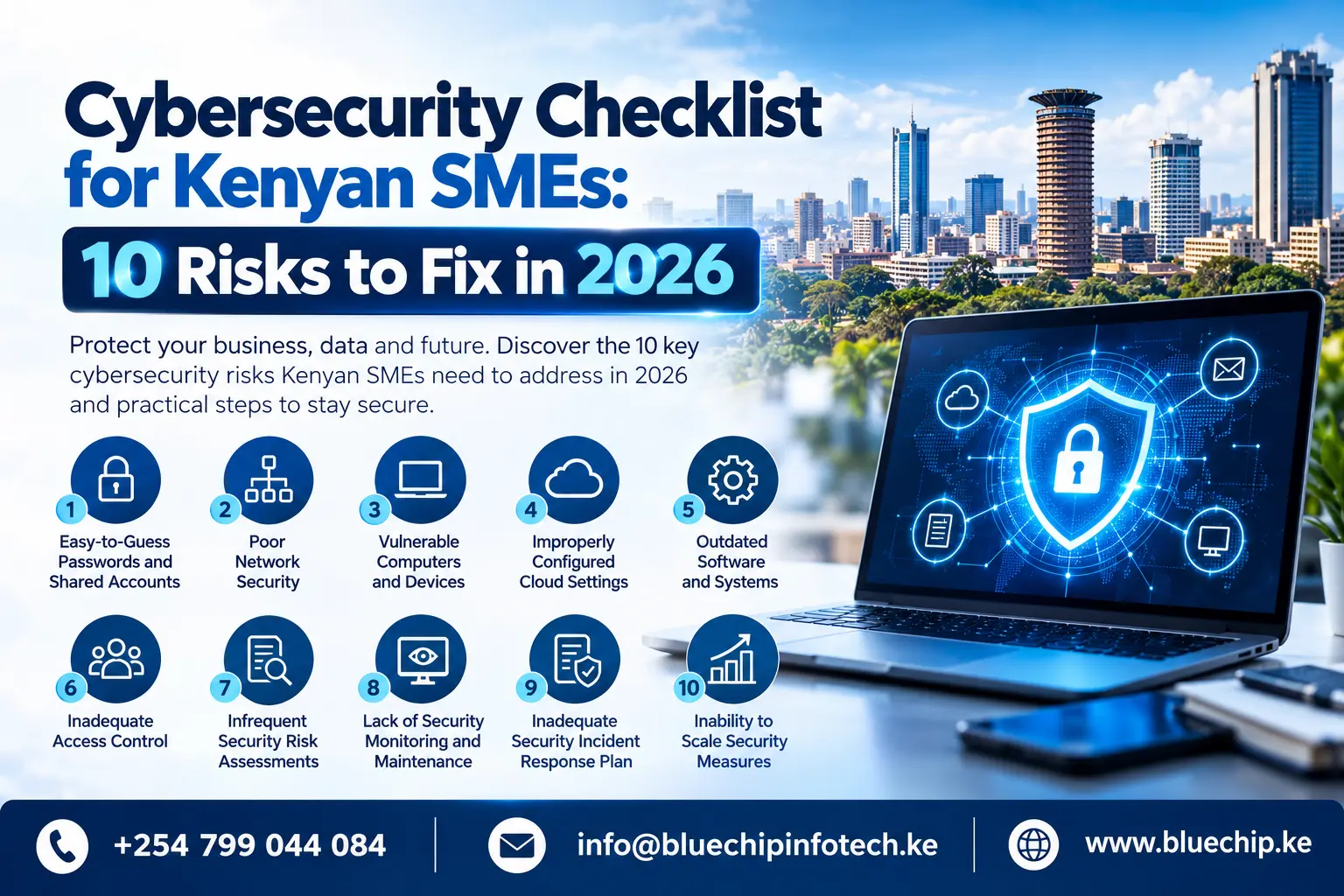
Cybersecurity Checklist for Kenyan SMEs: 10 Risks to Fix in 2026

As more small and medium enterprises (SMEs) adopt digital tools to support their operations, store information, and communicate with stakeholders, security vulnerabilities in networks and devices, data storage, cloud solutions, and access control mechanisms can introduce serious risks.
For businesses that want to improve their cybersecurity capabilities, local cybersecurity service providers should be able to deliver solutions to address immediate concerns and design long-term strategies to reduce exposure to threats. Nairobi-based BlueChip Technologies offers cybersecurity infrastructure and protection services to organisations that want to secure their networks, endpoints, and cloud environments.
Below are ten cybersecurity risks Kenyan SMEs should address in 2026.
1. Easy-to-Guess Passwords and Shared Accounts
Administrators and employees can provide attackers with easy access to business data if they use simple passwords or share email and social media accounts.
What to do: Protect business emails and social media accounts by changing weak and predictable passwords and removing shared accounts. Ensure that only authorised users have administrator rights.
2. Poor Network Security
Networks connect computers and other devices, including servers, using wired or wireless connections. The security of these connections and servers can be compromised if network settings are misconfigured.
What to do: Determine the source of insecurity in your business network and secure routers and other devices. Only allow approved users to access the network and install firewall systems to protect your data. BlueChip Technologies offers network security design and firewall installation and configuration services as part of its cybersecurity infrastructure solutions.
3. Vulnerable Computers and Devices
Computers, laptops, tablets, and other devices can store sensitive customer data, financial information, and other valuable business documents. Attackers can benefit from gaining access to these devices through unprotected networks or by stealing or compromising login credentials.
What to do: Protect all business devices by investing in the right end-user protection solutions and maintaining an inventory of all company devices. Limit administrator rights and ensure that devices have the latest security updates.
4. Improperly Configured Cloud Settings
Organisations that use cloud storage solutions to host data and applications must ensure that permissions and settings are configured correctly to avoid data breaches and illegal access to information.
What to do: Adjust cloud permissions and security settings to eliminate security gaps and protect sensitive information. Only provide administrators with the necessary rights to perform their duties and remove access to retired employees.
5. Outdated Software and Systems
Using obsolete software, operating systems, or network devices is a cybersecurity risk because known vulnerabilities in these systems often become publicly available, enabling attackers to compromise these systems with relative ease.
What to do: Subscribe to a company that provides regular updates and security patches for your operating systems and network devices or invest in new hardware and software to ensure there are no exploitable weaknesses. BlueChip Technologies manages and maintains network devices and provides patch update management services as part of its managed support services.
6. Inadequate Access Control
Employees can view, copy, or share sensitive information and data if their access rights enable them to reach these materials, even if they do not have a legitimate need for this data.
What to do: Restrict employee access to only the information and systems they need to perform their duties. Change access rights when employees switch roles and eliminate access rights when they leave. BlueChip Technologies offers cybersecurity access control and identity management services.
7. Infrequent Security Risk Assessments
Most businesses overlook potential security risks and weaknesses in their network infrastructure, network security configuration, and data storage settings.
What to do: Conduct regular risk assessments by analysing your network infrastructure, security system configurations, and access control lists to identify and address weaknesses. BlueChip technologies offers security assessment and risk evaluation services to help you identify and address cybersecurity concerns.
8. Lack of Security Monitoring and Maintenance
Cybersecurity is a continuous process, and businesses must invest in ongoing monitoring and maintenance to identify and address security threats and weaknesses. Cybercriminals can easily exploit weak maintenance practices and configuration errors to compromise networks and data.
What to do: Subscribe to a managed security service to ensure there are no security errors in your network system or invest in continuous network monitoring and maintenance. BlueChip Technologies offers managed support services that include system monitoring, maintenance, and optimization.
9. Inadequate Security Incident Response Plan
An organization does not benefit from cybersecurity solutions if it does not have procedures and staff to respond immediately when an attack occurs.
What to do: Develop an action plan and designate specific personnel to respond to security incidents to ensure there is no confusion and every responder knows their responsibilities during a cyberattack. Your network security plan should outline the procedures to follow after a cyberattack, the tools to use when reviving systems, and steps to take to minimize damage to data and systems. A security audit is also useful to identify vulnerabilities before an attack occurs.
10. Inability to Scale Security Measures
Expanding the business by adding more employees and devices or establishing new branches can create new security challenges as the existing cybersecurity infrastructure may not be able to address the growing complexity of the organization’s network and device ecosystem.
What to do: Consult cybersecurity experts to conduct a security assessment and recommend network security system changes and other adjustments to align with the company’s growth vision. BlueChip Technologies offers integrated security solutions that can support the unique needs of your organization, including SMEs, corporates, nonprofits, and multi-branch organizations.
How Can Kenyan SMEs Strengthen Their Cybersecurity?
Addressing these ten cybersecurity concerns should enable small and medium enterprises to establish the right cybersecurity strategy, identify areas that need reinforcement, and involve the right cybersecurity partner to advise and support them throughout the process.
BlueChip Technologies helps organizations to strengthen their cybersecurity postures, secure their data, and optimize their networks and systems. The company serves small businesses, corporations, and organizations that need to improve their cybersecurity capabilities and modernize their network infrastructure.
Conclusion
Cybersecurity should be a priority for all organizations that rely on digital technology to store data or facilitate communication. Understanding the ten cybersecurity risks outlined in this article should help Kenyan businesses identify areas to invest in to improve their cybersecurity capabilities.
If your organization is considering SME cybersecurity Kenya solutions, you can use the information on BlueChip Technologies’ website to understand how network security design, endpoint security, cloud security, and access control solutions can protect your data and systems.
FAQ
1. What are the main cybersecurity threats to businesses in Kenya?
Organizations in Kenya must deal with threats like phishing, ransomware, credential theft, and exploits. Denial-of-service (DoS) attacks also happen which cause websites and online services to become temporarily unavailable. These problems include sharing of private data, disruption of regular business operations and damage to the organization’s reputation. Businesses should study and understand these weaknesses in order to determine the best ways to safeguard their interests
2. How can a small business’s owner avoid phishing?
Organizations can counter and prevent phishing by raising awareness among workers about phishing schemes, encouraging them to look out for suspect links and attachments, confirming invoices through alternative emails, and applying multifactor authentication (MFA) when dealing with critical financial information. Workers should also be alerted in case of suspected phishing activity. For expert advice on business security needs, small business owners should contact Bluechip Kenya .
3. How frequently should a company perform a vulnerability assessment and review?
Companies should develop a system evaluation strategy based on their infrastructure and cybersecurity needs. A vulnerability scan should be conducted whenever there are changes in the system infrastructure and when newly discovered security flaws have the potential to introduce new vulnerabilities. The CIS Controls panel suggests “Continuous Monitoring and Scanning” , at least once every 6 months for internally-accessible enterprise systems and at least once every 12 months for externally-accessible enterprise systems. It is also critical to perform ongoing reviews, prioritize the most threatening flaws, and ensure that remediation actions are completed.
4. Is cyber insurance necessary for small and/or medium-sized businesses?
Depending on the terms covered by the policy, insurance may cover some of the losses and costs involved in data breaches, depending on the procedures followed. In Kenya, cyber insurance is administered on a case-by-case basis. Businesses should seek advice from an authorized insurance professional or broker to clarify their particular needs and requirements. Businesses should invest in cybersecurity insurance but not overlook the cruciality of implementing cybersecurity measures.