
Blog
IT AMC Contracts in Kenya: How to Ensure Preventative Maintenance & SLAs are Covered For Nairobi SMEs

More and more small-to-medium sized enterprises (SMEs) in Nairobi are relying on technology to run their businesses. Whether it’s computers, servers, networks, cloud and cyber security, a reliable IT setup is crucial.
To keep systems running smoothly, regular checks, support and preventative maintenance are required. If systems fail (unexpected hardware failure, network issues, etc.), this can cause disruption and loss of productivity for your staff. An IT Annual Maintenance Contract will help.
An IT AMC service in Kenya means that your business has a clear contract in place with your IT provider to ensure your IT is well managed.
For your SME in Nairobi, it is important to ensure you choose the right IT AMC provider by considering;
1. What will be covered by your IT AMC contract?
An IT Annual Maintenance Contract is a contract set up between your business and IT Provider to ensure your specific technology is well maintained, monitored and supported.
Depending on what IT services you want covered, your AMC might include:
- Desktop & Laptop Support
- Server support
- Network support
- Router, Switch & Firewall support
- Printer & Peripheral support
- Operating System & Software support
- Data Backup monitoring
- Basic Cybersecurity support
Ensure that any IT assets are documented and added to your contract.
Having a clear understanding of what will be covered will give you peace of mind.
2. What preventative maintenance is included?
One of the most important aspects of a good IT AMC is preventative maintenance. This means that your IT provider regularly checks your systems so any potential issues can be picked up before causing any disruption.
When shopping around for IT AMC services in Kenya, ensure you know how often visits will be made, what will be covered and how the reports will be handled.
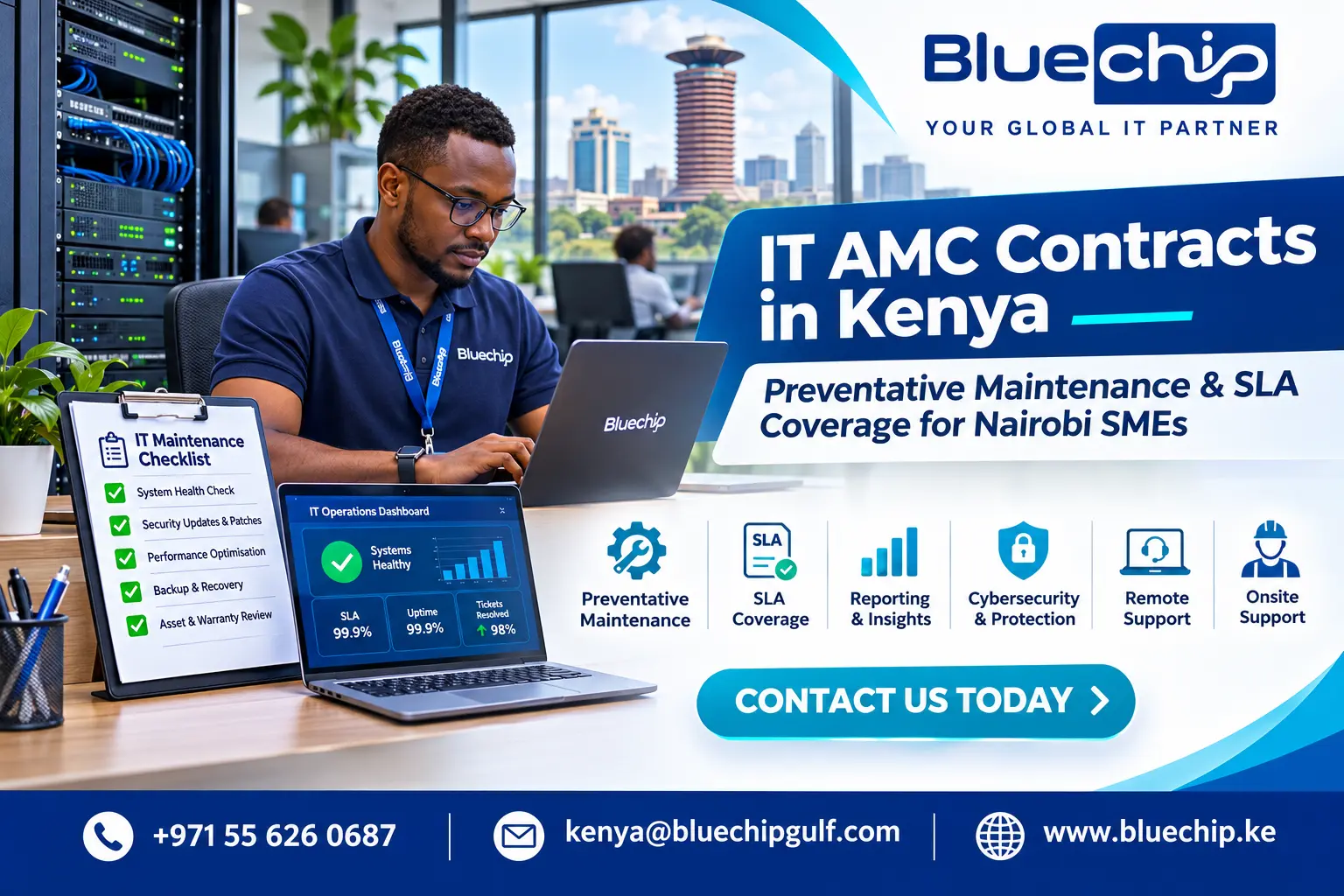
A good preventative maintenance checklist for your IT should include:
- Hardware
- Check if there are any physical issues with your computers, servers or networking.
- Check cooling systems and airflow.
- Identify any old/under performing hardware.
- Check UPS and backup systems.
- Software
- Check OS is up to date.
- Check applications are performing well.
- Remove unwanted software.
- Check Antivirus & Endpoint Protection.
- Networking
- Check Routers/Switches/Access Points.
- Check Networking Performance.
- Identify any unusual network activity.
- Check Firewall.
- Backup
- Check backups have been done.
- Check backup storage is available.
- Check data can be restored.
- Identify any potential issues with backups.
Decide how often you would like visits to occur (monthly, quarterly, based on your infrastructure).
3. What SLAs are included?
SLAs are an important part of your IT AMC. They tell you what level of support you can expect from your IT provider.
Before entering into an IT annual maintenance contract in Nairobi, ensure you consider the following:
- Response Time
- How quickly your provider will respond to your request.
- Resolution Time
- How quickly your issues will be resolved.
- Priority Levels
- What priority level your issues will be given (critical, high, medium, low).
- Support Hours
- If you will get support during business hours, extended hours or 24/7.
- Escalation
- What happens if your issues can’t be resolved.
- Reporting
- How your maintenance will be reported.
For example, a full network outage should be prioritised over a small software issue.
Ensure your SLA is realistic and measurable.
4. What support is offered remotely and onsite?
SMEs can suffer a variety of IT issues. Some may be small software issues whilst others may require onsite assistance.
A good IT AMC should clearly outline what support will be offered remotely and onsite.
Remote support can include:
- Software support.
- Email setup.
- User Account support.
- Basic diagnostics.
- Software updates & configuration.
- Onsite support can include:
- Hardware replacement.
- Server/Networking issue.
- Inspection.
- Printer/Connectivity issue.
- Installation & Configuration.
When shopping around for IT AMC services in Nairobi, ensure you know if onsite visits are included.
5. What aren’t they covering & what will cost extra?
A common mistake businesses make is to assume all IT related issues will be covered.
However, some services may not be covered and will cost extra.
Check if the following are covered or not:
- Hardware Replacement & Spares
- New Hardware Installation
- Major Infrastructure Upgrades
- Third Party Licences
- Data Recovery from Major Failures
- Damage to Equipment
- Devices not listed.
- Emergency Visits.
Ask your provider to write down what isn’t covered and what will cost extra.
This will help your SME in Nairobi understand what your budget will be for your IT and avoid any unexpected costs.
6. Have you listed your IT assets?
Having an accurate list of your IT assets will help your service provider know what they are supporting.
Before you begin or renew your IT AMC, ensure you have an updated list of your IT. This should include:
- Desktops/Laptop
- Servers/Storage.
- Switches/Routers.
- Firewalls.
- Printers/Scanners.
- Wireless Access Points.
- Licenced Software/Applications.
Ensure you have relevant details about your assets including where they are, how they are configured and any warranty information.
Also ensure you keep your list updated if you purchase new kit or replace any of your devices.
This will ensure your IT AMC covers the correct IT.
7. What cybersecurity will they provide?
Cybersecurity should be an important factor when choosing an IT AMC provider in Nairobi. More and more SMEs are using digital systems to hold information relating to their customers, finances & sensitive data.
Ask them what cybersecurity they will provide including:
- Antivirus & Endpoint Protection.
- Firewall monitoring.
- Patch Management.
- User Access.
- Email Security.
- Backup Monitoring.
- Vulnerability Spotting.
- Escalation Support.
Also ask who will be monitoring your security, checking your backups and reporting any issues.
Where applicable, ensure your organisation meets any data protection requirements in Kenya.
8. Are there reports?
Having regular reports will allow your management team to know the status of your IT and how well it is being maintained.
A professional IT AMC should provide you with reports including:
- Preventative Maintenance.
- Incidents/Tickets.
- Recuring Issues.
- Hardware Observations.
- Backups & Security.
- Recommendations.
This will help you identify any recurring issues, plan for hardware replacements and make informed decisions on your technology.
Ensure you know how often reports will be provided and who will be looking at them.
9. Can they scale with your business?
As your SME grows, your technology requirements may increase. You may have more staff, new offices, more data & new applications. You may need extra support.
Ensure your IT AMC can scale to include
- Extra computers/users.
- New servers/networking.
- Office relocation.
- Cloud.
- Extra Cybersecurity.
- More applications.
A flexible IT AMC provider in Nairobi should be able to adapt their service to fit your changing needs.
This means you always have the same level of support.
Conclusion
An IT AMC is not just a maintenance contract. It is an important part of managing your business’ technology. By considering preventative maintenance, SLAs, support, what isn’t covered, cybersecurity and reporting, your SME in Nairobi can get more value from yOur IT maintenance.
By choosing the right IT partner, you can ensure your business can focus on what they do best whilst knowing their technology is being well looked after.
Bluechip can help organisations manage their technology requirements. With the right maintenance, you can improve your reliability, resolve any issues and grow your operations.
Need reliable IT AMC services in Kenya? Get in touch with Bluechip.
FAQ
01 What should an IT annual maintenance contract include?
An IT AMc should include regular maintenance and technical support for your equipment. Services like computer check-UPS, server monitoring, network check-UPS, software updates, back-up checks, anti-virus monitoring, cleaning and help desk should all be included. It is important to know which devices are included, how many preventative visits will be provided, how many hours of support you will receive and how quickly a problem will be resolved. Businesses in Nairobi will benefit from having regular service reports to ensure your IT systems are running effectively.
02 How regularly should servers, computers and network devices be serviced?
Depending on the type of equipment and how often it is used, servers and firewalls will need regular check-UPS. Computers will need regular software updates. Cleaning, UPS checks and hardware checks can be done every quarter or as advised by the manufacture. If your offices suffer from dust or power problems then you may need more frequent checks. A good AMc should have a clear schedule showing when your equipment will be maintained and how urgent problems will be handled.
03 What parts, licences and consumables might not be included in an IT AMc?
Most IT AMcs will include maintenance and labour but will not cover any replacement parts. Hard drives, batteries, printer toner, switches, cloud, anti virus licences and large software updates are commonly excluded. Out of hours support and support for equipment not included in your inventory can be charged extra. Ask your provider to give you a clear breakdown of what will be included, what will not be included, licence costs and any extra costs. Knowing what equipment you have that is getting old will help you avoid any surprises.
04 How can businesses in Nairobi compare response time guarantees?
Ensure you understand what your provider means by response time. Do they mean the ticket has been acknowledged, or the issue has started being resolved? Are there different response times for critical, high priority and general issues? Do they offer out of hours support at the weekend? Check what their escalation process is. Will they keep you updated? Will they be delayed due to parts? Do they have third party support? Previous tickets, missed appointments and reoccurring issues can help you decide if you are receiving a good service. If they offer service credits or other solutions make sure this is clearly included.