
CMS SOLUTIONS
CMS Solutions for Business Websites and Content Teams
A content management system (CMS) gives your team a structured way to create, edit, organize and publish website content without rebuilding pages for every routine update. The right CMS should make day-to-day publishing easier while still supporting the design, security and technical requirements of the website.
Bluechip Kenya helps businesses plan and implement CMS solutions around how their teams actually work. That may involve configuring an established platform such as WordPress or another suitable open-source CMS, customizing an existing installation, migrating content from an older system, or developing a more specialized content-management experience when standard platforms do not fit the requirement.
The decision should be based on more than the editor screen. User roles, approval workflows, integrations, hosting, backups, maintenance, search visibility, performance and future changes all affect whether a CMS remains practical after launch.
CMS Capabilities Businesses Should Evaluate
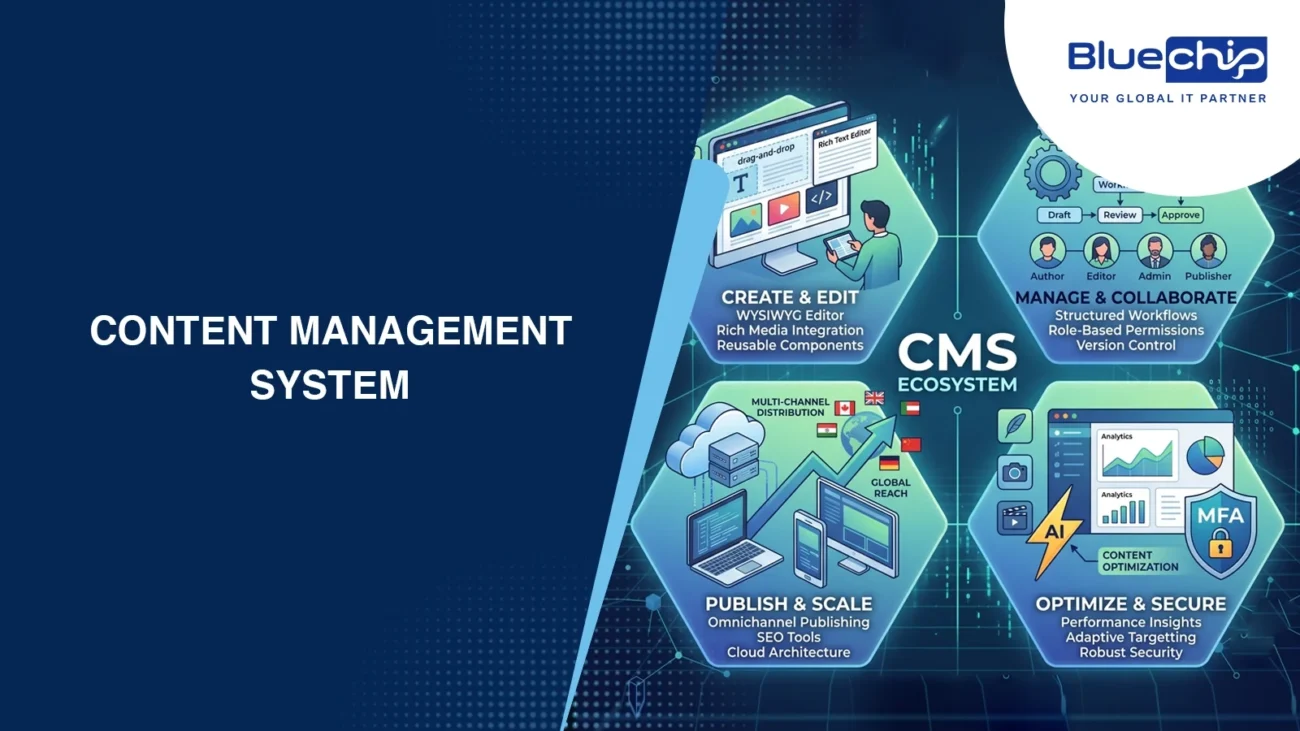
Easy content editing — authorized users should be able to update pages, images, documents and other routine content without unnecessary developer dependency.
User roles and permissions — different teams can be given appropriate access for editing, review, publishing and administration.
Content workflow — draft, review and publishing processes can be structured around the way your organization approves content.
Integration support — the CMS may need to connect with forms, CRM platforms, analytics, ecommerce, ERP systems, email tools or other business applications.
SEO and content controls — page titles, descriptions, headings, URLs, redirects and other on-page elements should be manageable where the platform allows.
Maintenance and security — updates, backups, access control, plugin/module governance and monitoring should be considered as part of long-term ownership.
Choosing the Right CMS Approach
There is no single CMS that is right for every organization. The most suitable option depends on the complexity of the website, how frequently content changes, how many people will manage it, which systems must integrate with it, and how much technical support the organization wants to retain.
Open-source CMS platforms can be a practical fit for many corporate, publishing and service websites when the required functionality is supported by the platform and its ecosystem. WordPress may suit teams that need familiar content editing and broad development support. Drupal or other structured platforms may be considered for more complex content models or permissions. A custom CMS may be justified when workflows, integrations or data structures are specialized enough that adapting a standard platform would create unnecessary complexity.
A CMS Should Stay Practical After Launch
A CMS should reduce friction for the people who manage the website without creating avoidable technical debt for the people who maintain it. Bluechip Kenya can help assess the current website, define content-management requirements, recommend a suitable approach and plan implementation or migration around the existing business environment.
Have a Website Project in Mind?
CMS Services Built Around Your Content Workflow
CMS projects vary widely, so the scope should be defined around the website and the team that will manage it. Depending on the requirement, a CMS engagement may include:
• CMS planning and platform recommendation based on content, users, integrations and maintenance needs.
• New CMS-based website development or CMS implementation within an approved design.
• Customization of templates, page components and content structures.
• User roles, permissions and publishing workflow configuration.
• Content migration from an older CMS or static website, including URL and redirect planning where required.
• Integration with forms, analytics, CRM, ERP, ecommerce, search or other supported business systems.
• SEO-friendly content controls where supported by the chosen platform.
• Administrator guidance, documentation and post-launch maintenance planning.
How We Approach a CMS Project
1. Understand the content operation — review users, content, approvals, integrations and pain points.
2. Define platform and architecture — map page types, content structures, permissions, hosting and security considerations.
3. Build, configure and migrate — implement the CMS and migrate agreed content.
4. Test publishing workflows — verify editor tasks, permissions, forms, links, redirects and integrations.
5. Launch with an ownership plan — define updates, backups, access reviews and maintenance responsibilities.
Why Choose Bluechip Kenya for CMS Projects
• Requirement-led planning around content, users, workflows and integrations.
• Connection to related web, application and ecommerce requirements.
• Migration-aware implementation with URL and content planning.
• Security-conscious administration covering access, updates and backups.
• Practical handover focused on day-to-day manageability.
FAQ
What is a CMS and why would a business use one?
A content management system is software used to create, organize, edit and publish website content. It can reduce routine dependence on developers by giving authorized staff controlled access to update pages, images, documents and other content.
Which CMS is best for a business in Kenya?
There is no single best CMS for every business. The right choice depends on the website structure, content volume, user roles, integrations, security requirements, internal skills, budget and long-term maintenance model. A requirements review should come before platform selection.
Can Bluechip Kenya work with an existing WordPress or other CMS website?
Potentially, yes. The first step is to review the current platform, theme or codebase, plugins/modules, hosting, security status and the changes required. Some websites can be improved in place, while others are better migrated or rebuilt.
Can we keep our existing website design and change only the CMS?
Sometimes. It depends on how the current front end is built and how tightly it is connected to the existing CMS. A technical review is needed to determine whether the design can be retained, adapted or recreated efficiently.
What should be planned before a CMS migration?
Plan content inventory, URL mapping, redirects, media files, metadata, user roles, forms, integrations, analytics, backups and launch testing. For established websites, preserving important URLs and search visibility should be part of the migration plan.
Can a CMS integrate with CRM, ERP or other business systems?
Many CMS platforms can integrate with external systems through APIs, approved extensions or custom development. Feasibility depends on the CMS, the external system and the data or workflow that needs to move between them.
How do user roles and approval workflows work in a CMS?
A CMS can assign different permissions to administrators, editors, authors or other user groups. Depending on the platform, content can move through draft, review and publishing stages so that not every user has full administrative access.
What ongoing maintenance does a CMS website need?
Typical responsibilities include software and extension updates, backups, security monitoring, access reviews, performance checks and testing after major changes. The exact maintenance plan depends on the chosen platform and hosting environment.